
Look for the blue banner below and read this entry in English!
El desarrollo de un juego es un proceso largo, lleno de giros, excitante y tedioso a partes iguales. Es una etapa que comienza desde que el juego es jugable hasta que va a la imprenta. Una etapa larga y difícil pero tan necesaria como gratificante.
Y también llena de encontronazos.
Cuando el juego pasa a ser jugable, uno empieza a encontrar rupturas por doquier, bucles ridículos, combinaciones extrañas, mecánicas más que imperfectas, agujeros del tamaño de un estadio… Es entonces cuando el desarrollo, o mejor dicho, sus desarrolladores entran en escena e impactan de lleno en el diseño.
Guerrilleros no es una excepción: su desarrollo está aclarando, simplificando y redondeando el diseño, acercándolo cada vez más a su estado final.
Esta entrada de los diarios es más «teórica» que práctica, pues hago un resumen de algunas de las consecuencias del desarrollo, pero me ha parecido interesante dejar aquí algunos de esos cambios y conclusiones.
Refinamiento o guillotina
Gracias a la enorme y desinteresada ayuda del desarrollador de Guerrilleros, Carlos Gete, así como a las contribuciones de testeadores con el colmillo afilado, el juego fue zambullido en esta etapa de desarrollo hace ya año y medio. Durante este tiempo hemos abordado todas las mecánicas en todos sus aspectos: su equilibrio, su proporcionalidad, su rentabilidad coste-efecto, su trasfondo, la facilidad de aprendizaje y ejecución, efectos a corto y largo plazo, su elegancia… Todo con el objetivo de mantenerlas, refinarlas o, en el caso de algunas, eliminarlas.
La mecánica principal que se ha beneficiado del desarrollo del juego ha sido el sistema de combate, descrito y ejemplificado en entradas anteriores. Inicialmente propuesto de forma funcional pero laxa, su revisión se abordó lo antes posible al comenzar el desarrollo del juego para conseguir tener un sistema robusto, elegante y de azar templado. El sistema se reforzó dándole el mayor significado posible a cada resultado. Se completó con consecuencias temáticas y se pulió para que incluso los casos más extremos fueran infrecuentes pero proporcionales. Los enfrentamientos más comunes, numéricamente hablando, se equilibraron para que se mantuviera la motivación de combatir y a la vez se proporcionaran las consecuencias de una victoria o derrota. El resultado es un sistema elegante (se resuelve con una sola tirada de dados), de efectos coherentes y proporcionales a la fuerza aportada al combate por cada bando, ligeramente modificado por el lugar donde transcurre el combate, y con una componente de azar que recompensa la preparación frente a la improvisación.
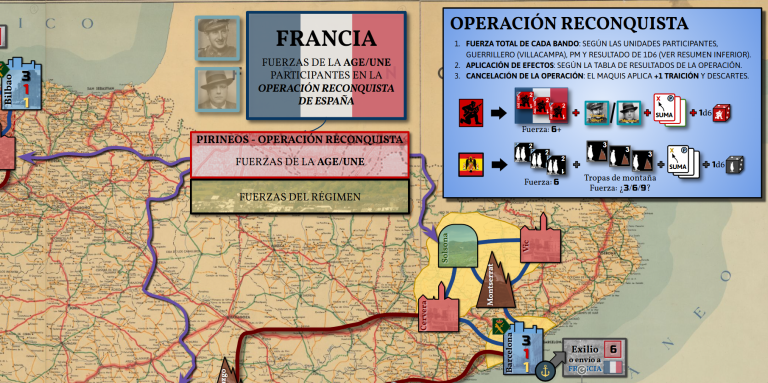
Otra mecánica paradigmática que ha sido enormemente ‘refinada’ ha sido la de la Operación Reconquista, tal y como conté en la entrada anterior. Después de probarla numerosas veces, la conclusión fue inevitable: guillotina. Jugar la operación tal y como se planteaba extendía mucho la duración del juego, implicaba modificar temporalmente o añadir reglas existentes, causando confusión, y no aportaba un gran cambio al resto del juego. Tras una simplificación brutal (hachazo va, hachazo viene) a nivel de tiempo y métodología empleados en ella, hemos encontrado el espacio adecuado para la operación. Ahora es poco más que un evento autoresoluble, una operación que sigue en manos del bando guerrillero, que exige gran preparación a ambos bandos si ninguno quiere sufrir consecuencias graves derivadas de la misma, pero que ocupa el tiempo y espacio que debe ocupar: 2-3 minutos frente a los 15-30 minutos que ocupaba antes.
Otra consecuencia de ese desarrollo es la simplificación y reducción de las maniobras de cada bando. Si bien todas tenían su sentido y utilidad, las pruebas han demostrado cómo algunas eran muchísimo menos usadas que otras, o cómo el impacto de algunas era regularmente superior al de otras que, de inicio, parecían tanto o más importantes. Ante todo ello, las decisiones fueron claras:
- Se han redefinido y complementado algunas maniobras (e.g. despliegue de unidades franquistas)
- Se han eliminado otras (e.g. desinformación, de la guerrilla)
- Se han integrado dos en una (e.g. apoyo y enlace, de la guerrilla).
El resultado es que cada bando tiene un total de 4 maniobras posibles, con su coste, y en ocasiones, con sus posibles efectos, a elegir en el momento de su ejecución.
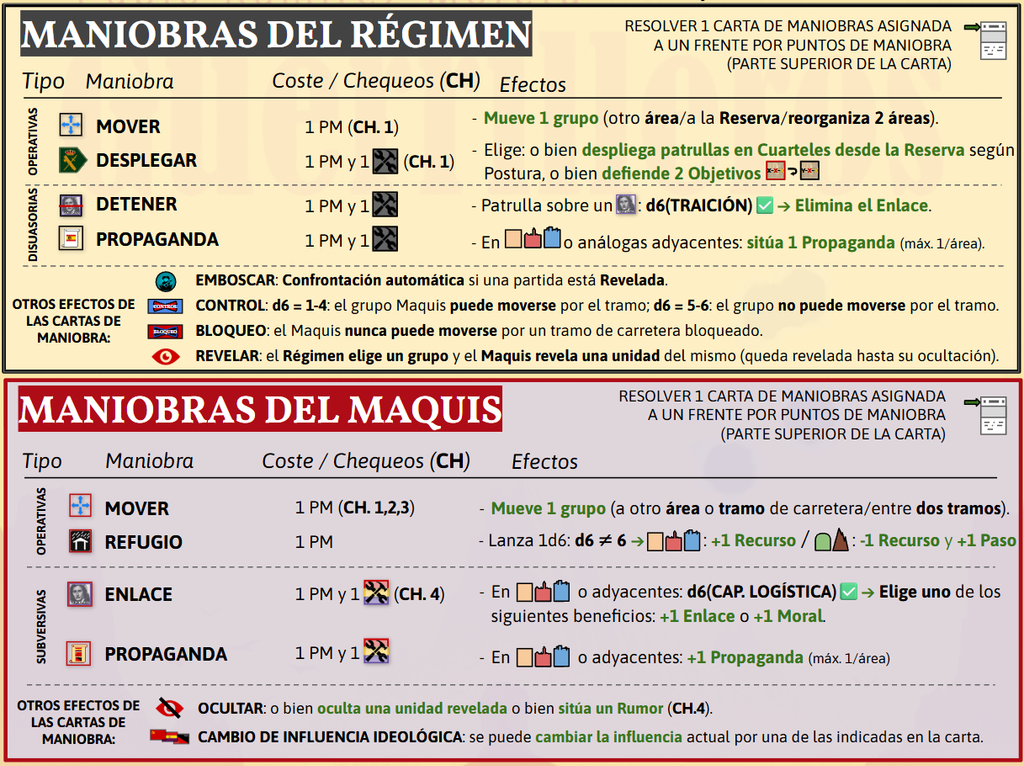
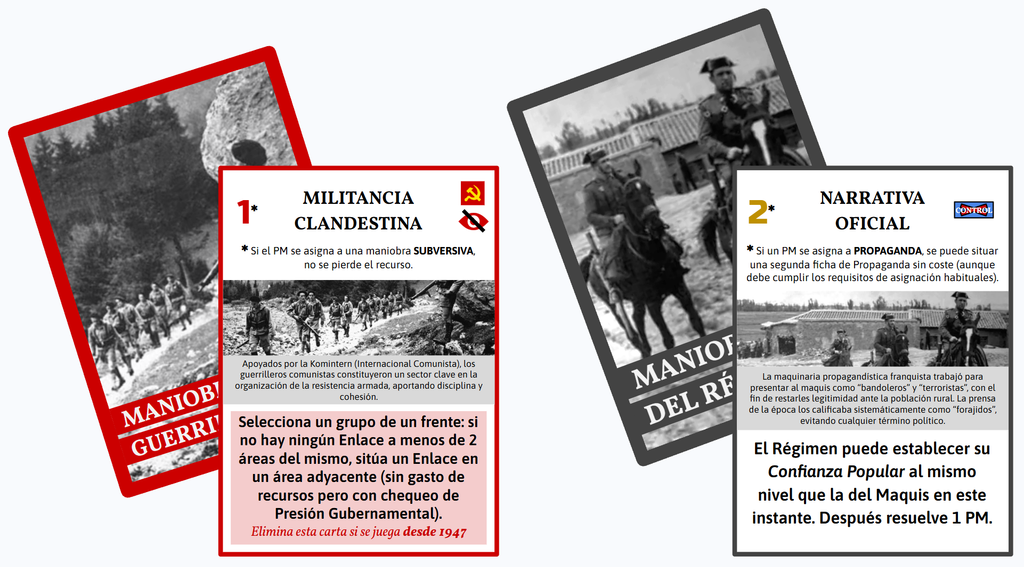
Las cartas de maniobras (en realidad el resto también) también han pasado por una revisión para mejorar no solo la jugabilidad sino buscar su simplificación con iconos y textos más claros. A riesgo de ser redundante, aprovecho para decir que todas las imágenes que ves en estas entradas son del prototipo y ninguna es definitiva.
Dado que esta entrada ha tenido más de reflexión que de actualización, la cierro aquí con una breve conclusión:
GUERRILLEROS AVANZA INEXORABLEMENTE HACIA SU FINALIZACIÓN
PRONTO LLEGARÁN NOTICIAS PARA LA CAMPAÑA DE TESTEO ABIERTO (vía módulo de Vassal)
¡Gracias por tu tiempo e interés!
English version
The development of a game is a long process, full of twists and turns, as exciting as it is tedious. It is the stage that begins when the game becomes playable and ends when it goes to the printer. A long and difficult stage, but one that is as necessary as it is rewarding.
And one that is full of clashes, too.
Once a game becomes playable, you start to discover breakdowns everywhere, ridiculous loops, strange combinations, mechanics that are far from perfect, holes big enough to fit a stadium through… This is when development – or, more accurately, the developers – enter the picture and make a direct impact on the design.
Guerrilleros is no exception: its development is helping to clarify, simplify and refine the design, bringing it ever closer to its final form.
This instalment of the design diaries is more theoretical than practical, as I look back at some of the consequences of the development process. Still, I thought it would be interesting to share some of the changes and conclusions we have reached along the way.
Refinement or the Guillotine
Thanks to the enormous, selfless help of Guerrilleros developer Carlos Gete, along with contributions from playtesters with a keen eye for flaws, the game entered this development phase a year and a half ago. Since then, we have examined every mechanic from every angle: its balance, proportionality, cost-effectiveness, thematic grounding, ease of learning and execution, short- and long-term effects, elegance… The aim has been to keep each mechanic, refine it or, in some cases, eliminate it altogether.
The core mechanic that has benefited most from the game’s development has been the combat system, described and illustrated in earlier instalments. Initially proposed as a functional, if somewhat loose, system, it was revisited as early as possible in the development process to ensure that it would be robust, elegant and governed by a measured degree of randomness.
The system was strengthened by giving each possible outcome as much meaning as possible. Thematic consequences were added, and the mechanics were fine-tuned so that even the most extreme outcomes would be rare, yet proportionate. The most common engagements, in numerical terms, were balanced to preserve players’ motivation to fight while ensuring that victory and defeat both carried meaningful consequences.
The result is an elegant system (resolved with a single dice roll), with coherent outcomes proportionate to the strength committed to combat by each side, modified slightly by the location where the fighting takes place. Its element of chance rewards preparation over improvisation.
Another prime example of a mechanic that has undergone extensive ‘refinement’ is Operation Reconquest, as I explained in the previous instalment. After trying it out numerous times, the conclusion was inevitable: the guillotine.
Playing the operation as originally conceived significantly extended the game’s duration. It also required existing rules to be temporarily modified or new ones to be added, causing confusion, without making a substantial difference to the game as a whole.
After some brutal simplification (one chop after another), particularly in terms of the time and procedures involved, we found the right place for the operation within the game. It is now little more than a self-resolving event: an operation that remains in the hands of the guerrilla player and requires careful preparation from both sides if neither wants to suffer serious consequences. Crucially, it now takes up the time and space it deserves: 2–3 minutes, compared with the 15–30 minutes it used to require.
Another consequence of development has been the simplification and reduction of each side’s manoeuvres. Although every manoeuvre had its own purpose and use, playtesting showed that some were used far less frequently than others, while the impact of certain manoeuvres was consistently greater than that of others which had initially seemed just as important, if not more so. The decisions were clear:
- Some manoeuvres have been redefined and expanded (e.g. the deployment of Francoist units).
- Others have been removed (e.g. guerrilla disinformation).
- Two have been combined into one (e.g. guerrilla support and liaison).
As a result, each side now has a total of four possible manoeuvres, each with its own cost and, in some cases, alternative effects to choose from when it is carried out.
The manoeuvre cards (and, in fact, the other cards as well) have also undergone a review, aimed not only at improving gameplay but also at simplifying things through clearer icons and text.
At the risk of repeating myself, let me take this opportunity to point out that all the images you see in these instalments are from the prototype, and none of them is final artwork.
Since this instalment has been more about reflection than providing an update, I’ll leave you with a brief conclusion:
GUERRILLEROS IS MOVING INEXORABLY TOWARDS COMPLETION
NEWS ABOUT THE OPEN PLAYTESTING CAMPAIGN (VIA A VASSAL MODULE) WILL BE COMING SOON
Thank you for your time and interest!